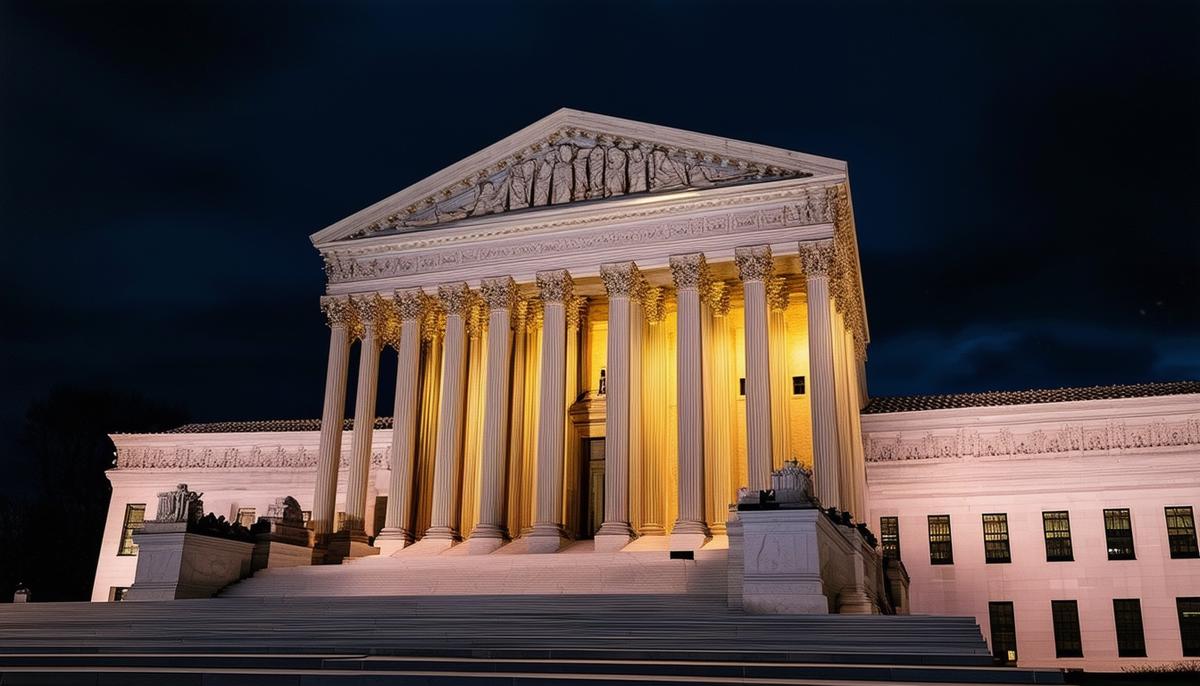
Five Constitutional Questions
Consolidated petitions addressing fundamental civil rights violations
- • Brady v. Maryland procedural violations
- • Substantive due process claims
- • ADA Title II access violations
- • Section 504 discrimination claims
- • Municipal liability under Monell
Critical Legal Issue
Prosecution's alleged failure to disclose exculpatory evidence in violation of Brady v. Maryland, 373 U.S. 83 (1963)
Executive Summary
This petition for a writ of certiorari presents a multifaceted constitutional challenge arising from alleged violations of due process under the Fifth and Fourteenth Amendments, focusing on the prosecution's failure to disclose exculpatory evidence as mandated by Brady v. Maryland, 373 U.S. 83 (1963).
The petitioner, Caustin McLaughlin, contends that his constitutional rights were violated during criminal proceedings in Baltimore City, Maryland, and that subsequent federal court proceedings failed to provide adequate remedies. The case consolidates five distinct but related constitutional questions, addressing the integrity of the criminal justice system, the accountability of law enforcement and prosecutorial entities, and the protection of individual civil rights in the face of alleged governmental misconduct.
"The petition seeks to establish a clear precedent that reinforces the obligations of prosecutors under Brady and holds government entities accountable for policies or customs that permit such violations to occur, particularly in cases involving defendants with disabilities."
Constitutional Challenge to Brady Violations
The core of this constitutional challenge revolves around the prosecution's alleged failure to disclose exculpatory evidence, a principle established in Brady v. Maryland, and the subsequent arbitrary deprivation of liberty that resulted from these actions. The petition argues that the lower federal courts' inadequate response to these violations necessitates Supreme Court intervention to clarify and reinforce fundamental constitutional protections.
Key Allegation
The prosecution deliberately withheld critical information that Jeffrey Callicutt, the key witness, had outstanding felony warrants at the time he initiated charges against the petitioner—material information that directly impeaches his credibility.
Legal Framework
- • Brady Standard: Disclosure of favorable evidence
- • Materiality Test: Could affect outcome
- • Due Process: Fifth & Fourteenth Amendments
- • Witness Credibility: Fundamental to fair trial
Procedural Due Process Violation
The prosecution's failure to disclose favorable impeachment evidence violates the petitioner's procedural due process rights under the Fifth and Fourteenth Amendments. This information was crucial for challenging the credibility of the key witness against him.
Substantive Due Process
Continued prosecution despite knowledge of witness's fugitive status constituted arbitrary deprivation of liberty without due process of law.
Constitutional Violations Framework
Brady v. Maryland Violations
Withholding of Favorable Impeachment Evidence
The Petitioner's case presents a significant procedural due process violation under Brady v. Maryland, 373 U.S. 83 (1963), which established the constitutional obligation of the prosecution to disclose evidence favorable to the accused.
Critical Withheld Evidence:
- • Outstanding felony warrants against Jeffrey Callicutt
- • Fugitive status at time of initiating charges
- • Evidence of fraud and perjury in complaint
- • Information affecting witness credibility and bias
Materiality Standard
Under United States v. Bagley, 473 U.S. 667 (1985), evidence is material if there is a reasonable probability that its disclosure would have changed the outcome of the proceedings.
Impact on Right to Fair Trial
Constitutional Violations
- • Deprived of opportunity to challenge key witness credibility
- • Denied meaningful opportunity to present complete defense
- • Violation of Fifth Amendment due process rights
- • Violation of Fourteenth Amendment fair trial guarantees
Systemic Implications
- • Undermines adversarial system integrity
- • Creates uneven playing field between prosecution and defense
- • Perpetuates culture of prosecutorial impunity
- • Threatens public confidence in justice system
Substantive Due Process Violations
Arbitrary Deprivation of Liberty
The continued prosecution of the Petitioner despite the prosecution's full knowledge of Callicutt's fugitive status constituted an arbitrary deprivation of liberty without due process of law. This claim goes beyond procedural requirements and challenges the fundamental fairness of governmental action.
Arbitrary Action
Government conduct lacking legitimate purpose or rational basis
Liberty Interest
Fundamental right to be free from unwarranted governmental restraint
Due Process
Constitutional protection against arbitrary government action
Lack of Accountability Mechanisms
The Petitioner's case highlights a critical deficiency in the current system of accountability for law enforcement and prosecutors who engage in misconduct. Despite clear evidence of wrongdoing, lower federal courts failed to protect the Petitioner's liberty interests.
ADA and Section 504 Violations
ADA Title II Violations
Federal courts in the Eastern District of Virginia and Fourth Circuit Court of Appeals violated Title II of the ADA by failing to provide reasonable accommodations for the Petitioner's auditory processing deficits.
Disability Accommodations Needed:
- • Assistive listening devices
- • Real-time captioning services
- • Extended time accommodations
- • Modified communication methods
Section 504 Violations
Federal courts violated Section 504 of the Rehabilitation Act by discriminating against the Petitioner in federally funded programs and activities due to his disability.
Legal Requirements:
- • Reasonable modifications
- • Equal opportunity to participate
- • Effective communication
- • Accessibility compliance
Impact on Judicial Access
Accessibility Barriers
The Petitioner's auditory processing deficits affected his ability to understand speech in courtroom environments, particularly without appropriate accommodations.
Systemic Exclusion
Failure to provide necessary accommodations created barriers that prevented full and equal participation in judicial proceedings.
Municipal Liability and Sovereign Immunity
Monell Municipal Liability
The municipality of Baltimore is liable under Monell v. Department of Social Services, 436 U.S. 658 (1978) for policies or customs that led to constitutional violations.
Policy or Custom Evidence:
- • Failure to train and supervise prosecutors
- • Inadequate policies to prevent Brady violations
- • Pattern of constitutional violations
- • Deliberate indifference to civil rights
Ex Parte Young Exception
Government officials are not entitled to sovereign immunity under Ex Parte Young, 209 U.S. 123 (1908) when their actions violate constitutional rights.
Sovereign Immunity Challenge:
- • Quasi-judicial immunity improperly invoked
- • Actions outside scope of official duties
- • Constitutional violations require accountability
- • Injunctive relief available under Young
Need for Structural Equitable Remedies
The systemic violations of constitutional rights in this case require structural equitable remedies beyond traditional monetary damages or injunctive relief.
Consent Decree
Court-supervised reform of municipal policies and procedures
Court Monitor
Independent oversight of criminal justice system reforms
Training Programs
Comprehensive education on constitutional obligations
Integration of Technology and Civil Rights
Post-Quantum Cryptography
Advanced PQC algorithms protect sensitive judicial data while ensuring compatibility with legacy forensic tools and maintaining universal accessibility standards.
Technical Requirements:
- • Python: KyberPy==3.1.0, NTRUPrimeRef==1.2.4
- • R: pqcrypto==0.8.6, latticeCryptoSuite==2.0.9
- • Hardware: Intel i7+, 32GB RAM recommended
- • Quantum-resistant encryption standards
GovLLM Accessibility System
Open-source generative language model specifically fine-tuned with ADA compliance features for enhanced judicial accessibility.
Accessibility Features:
- • Sign language animation and interpretation
- • Dyslexia-friendly fonts and formatting
- • Braille output streams and haptic feedback
- • Multimodal interaction channels
Technology Integration Framework
Balancing Technology and Equity
While emerging technologies offer enhanced efficiency and accessibility, they must be implemented in ways that honor bedrock equality principles and do not create barriers for vulnerable populations.
Legal Framework and Jurisdiction
Supreme Court Jurisdiction
This Court has jurisdiction under 28 U.S.C. § 1257(a) over appeals from the denial of writ of mandamus by the Fourth Circuit Court of Appeals.
Jurisdictional Basis:
- • Final judgment from court of appeals
- • Federal question presented
- • Constitutional issues raised
- • National importance of questions
Constitutional Provisions
Multiple constitutional amendments provide the framework for protecting the Petitioner's fundamental rights.
Invoked Amendments:
- • First Amendment - Fundamental rights
- • Fourth Amendment - Due process
- • Fifth Amendment - Due process
- • Sixth Amendment - Fair trial
- • Eighth Amendment - Cruel punishment
- • Fourteenth Amendment - Equal protection
Statutory Framework
Civil Rights Statutes
- • 42 U.S.C. § 1983: Civil action for deprivation of rights
- • 42 U.S.C. § 12101: Americans with Disabilities Act
- • 29 U.S.C. § 794: Section 504 Rehabilitation Act
- • 42 U.S.C. § 12131: ADA Title II provisions
Federal Rules and Regulations
- • 28 C.F.R. Part 35: ADA regulations
- • 28 C.F.R. Part 36: Public accommodation standards
- • Fed. R. App. P. 10(c): Appellate procedure
- • Fed. R. Civ. P. 12(b)(6): Motion to dismiss
Questions Presented for Review
1 Brady Violations and Witness Credibility
Whether lower federal courts violated Petitioner's constitutional rights under Brady v. Maryland when deliberately ignoring evidence undermining the credibility of witnesses involved in bringing unrelated criminal charges?
2 ADA and Section 504 Compliance
Do ongoing technical infrastructure upgrades implemented across national judiciary systems qualify automatically for exception from standard accessibility requirement compliance mandated by the ADA and Section 504?
3 Deliberate Indifference and Bivens Remedies
Does the deliberate failure of public agencies and courts to implement automated systems supporting accessible litigation platforms constitute deliberate indifference to disabled citizens' equal justice under law thereby giving rise to Bivens-type remedies?
4 Quantum-Resistant Cryptography and Universal Access
When does the integration of quantum-resistant cryptographic methods into public legal databases trigger special obligations regarding universal access regardless of physical condition?
5 Civil Rights Protections for Emerging Technologies
Should emerging technologies designed specifically to enhance public access to judicial information become subject to the same civil rights protections governing traditional courthouse environments?
Supplementary Technological Questions
With advances in Post Quantum Cryptographic (PQC) algorithms increasingly embedded throughout digital infrastructure affecting all public agencies—including courts—the need emerges for uniform standards ensuring these newer forms still honor bedrock equality principles.
Technical Exhibits and Supporting Documentation
PQC Algorithm Integrations
Technical exhibits document the implementation of lattice-based cryptography resistant to quantum computer decryption attacks, ensuring continued confidentiality and integrity of sensitive judicial data.
File Structure:
- •
/pqc_algorithms/hybrid_kyber_ntru/main.py - •
/testing/pqc_performance_benchmark_notebook.ipynb - •
/pipelines/data_validation_flow_r.r
GovLLM Accessibility System
Open-source generative language model specifically fine-tuned with ADA compliance features, enabling seamless interpretation and conversion across multiple accessibility formats.
System Components:
- •
/govllm/core/accessibility_adapters/tts_reader.py - •
/notebooks/narrative_translation_demo.ipynb - •
/services/accessibility_gateway_rest_api.py
Appendices and Supporting Documents
Legal Proceedings Documentation
- • Appendix A: District Court Civil Docket Entries
- • Appendix B: District Court Criminal Docket Entries
- • Appendix C: Fourth Circuit Court of Appeals Order
- • Appendix D: Certificate of Service
Technical Implementation
- • Appendix E: Technical Exhibits Supporting Petitions
- • Appendix F: Production-Ready Notebooks & Architecture
- • Build Instructions: Complete component lists and testing protocols
- • Compliance Reports: Standards verification and licensing
Respectfully Submitted
These consolidated petitions present fundamental questions of constitutional law that require Supreme Court intervention to protect individual rights, ensure judicial accountability, and establish clear precedent for emerging technological challenges in the justice system.
Respectfully submitting five consolidated Petitions for Writ of Certiorari to Your Honors, each individually supported by extensive technical exhibits documenting prototype implementations currently undergoing peer-review prior to potential commercial deployment worldwide.